Awh, Dangit.
The year is 2009. I am five years old, and So Many Dynamos has released their third album, a large enough release to pick up the attention of Pitchfork (thunderclap) (screams). At the time, they reigned as one of the kings of music criticism. Anything they deemed cool is cool, and anything they deemed uncool… well, god help them all. And god help the Dynamos.
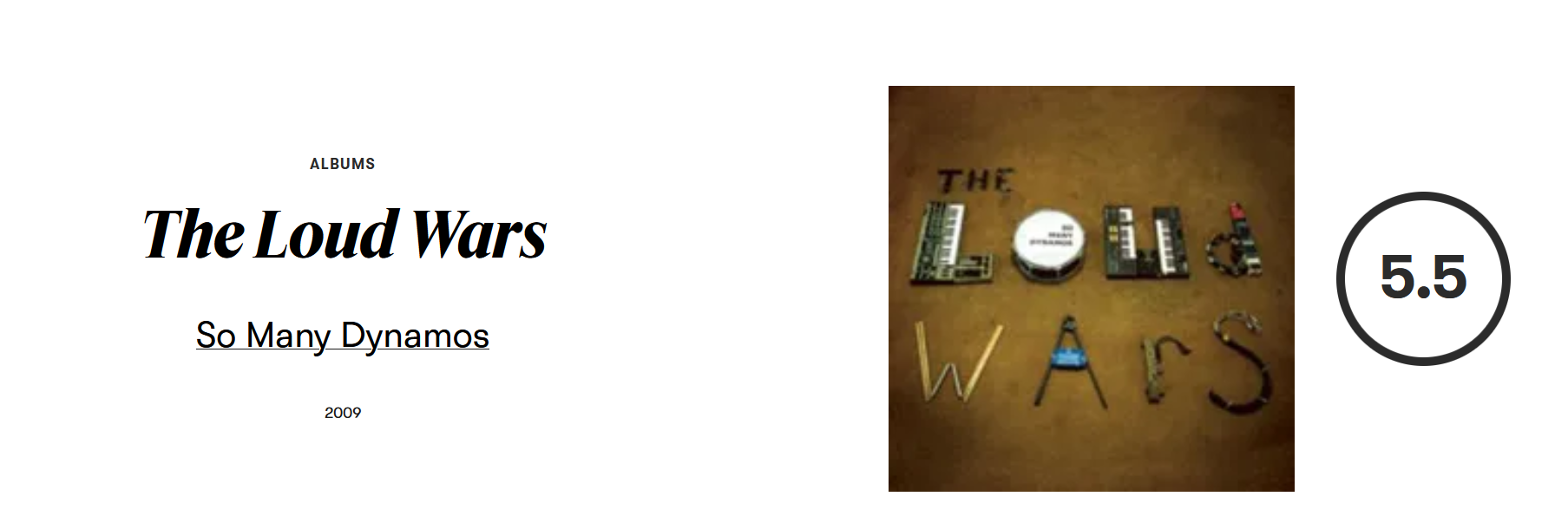
The review, written by one Paul Thompson, would end up completely tanking the band’s career. Though they ultimately did not break up, they just about vanished from the face of the earth. Just a few scattered live performances and a fourth album six years later that picked up next to zero attention.
However, there is one problem. One that would come to light many years later, well after Thompson’s time at Pitchfork had come to a close. The review was actually pretty bad.
Since the release of their debut album in When I Explode, the Dynamos had been known almost exclusively as a clone of Dismemberment Plan. Even then, they weren’t exactly a carbon copy either. Tracks like “Heat/Humidity” and “Windows Facing Walls” has some serious heat behind them without feeling like they were cut from Emergency & I. Even with the baggage, they had glimmers of their own identity that were further expressed in Flashlights. They leaned hard into a more complex “math-y” style, mostly exhibited through Wasoba and Kay on guitar. Kunstel absolutely carries, though. His drumwork gives the entire album tons of energy, even through the slower-paced tracks. He would probably be my favorite drummer of all time if Louis Cole didn’t exist (though that’s hardly fair). Still, Stovall does drag things down. His lyricism is great, and he doesn’t really put up any one performance here that I could pick out as egregiously bad or anything, but man is he underwhelming. He has a narrow range, flat delivery, and is “Morisson-esque” enough to draw some really unflattering comparisons. But despite that, Flashlights proves that the Dynamos are their own band. All the bits they’ve loaned from the ‘Plan have been streamlined to the point of being unrecognizable. They aren’t “that one D-Plan clone” anymore. They are So Many Dynamos. And yet here we are.
Pitchfork’s review for The Loud Wars completely fucked So Many Dynamos. Their influence on music culture was such that, as Bryan Sutter puts it in his article with TheArtsSTL, “people would have played with room temperature mercury barehanded in traffic if Pitchfork said it were cool”. No matter the quality of the review itself, that 5.5 said enough on its own. Pitchfork said the Dynamos weren’t cool, so they weren’t. That’s that. All we’re left with is the text itself. What does our Paul Thompson actually have to say?
Sparing no time, Thompson’s review is immediately obsessed with D-Plan references, though he does it in a very odd way. Rather than drawing any comparisons between the two bands musically or structurally, he instead decides to make confusing references turn-of-the-century DC politics at nearly every opportunity. No, I am not kidding. Quite literally every paragraph includes lines such as: “Any D.C. band worth its loft space had to have a rhythm section as locked-in as the Republican-controlled Congress” and “But it's 2009, and as you're well aware, D.C.'s turned over a couple times now, which makes what So Many Dynamos are doing roughly as fresh as a Linda Tripp joke”. With one-liners and political deep-cuts like these, you’ll almost forget the tasteful 9/11 joke.
Baffling creative throughline aside, the review simply does not prioritize many of the standard elements of an album review. Take another Pitchfork review for example. Their review of Flashlights was very standard, if a little sparse. It addressed and acknowledged the history and popular perception of the band, but just as quickly delved into more technical details. Sound, production, standout tracks, the works. All the elements of the listening experience. Thompson keeps such talk to a minimum and, when he does choose to bring it up, steeps it in enough irony to make you taste pennies. He undercuts each and every instance of genuine critical insight with bad jokes or sarcastic allusions. It makes for an exhausting and confusing read, through and through.
This is the review that killed the Dynamos. This is the weight of a publication’s influence brought down through the dexterous hand of a drunk surgeon. It’s a damn shame.