Preface
I don’t know So Many Dynamos. I wasn’t even alive when they were starting out. I’m certainly not from St. Louis. Hell, I’m not even that big of a math rock fan or anything. I only even came across them by chance. I was looking into a band called Semaphore that was mentioned in a live radio performance by Emperor X, and their Wikipedia page happens to contain the words “Semaphore” and “Emperor X”. I never did happen upon Semaphore, but I’m so glad I didn’t. So Many Dynamos has become special to me. I had never heard a band like them when I first loaded up Flashlights, and I haven’t since.
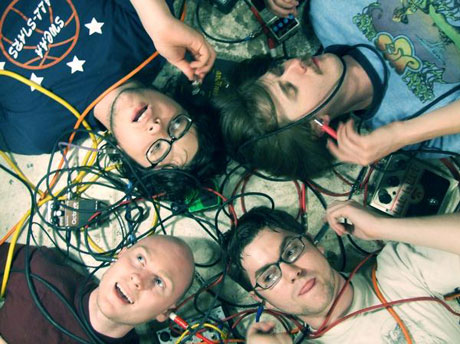
So Many Dynamos was a St. Louis-based math rock and post-punk band inspired by turn-of-the-century DC bands like Q and Not U and Dismemberment Plan to a fault. With the release of their first album, When I Explode, reviews almost unanimously concluded them to be something of a clone of Dismemberment Plan. Those comparisons would ultimately haunt the band up until the release of The Loud Wars, where a scathing review from Pitchfork would more or less kill the band. Though they would end up sticking together and putting out another album a few years after the review, they never again drew the same attention they once had, meager as it was.
There’s largely a drought of sources for this band outside of some contemporaneous professional reviews and a few recordings of live shows. These sources were found through DuckDuckGo, my search engine of choice, as well as YouTube, which helped to find the aforementioned live recordings. This sample is joined by a pair of reports on their 2023 farewell show in St. Louis, which provides some much-needed retrospective commentary and even some quotes from the band themselves. A promo interview for The Loud Wars, while naturally somewhat unreliable as a source due to its role as promotion, does provide some rare perspective from the band itself. Though hardly exhaustive, these sources give a wide enough breadth of perspectives over time to give a comprehensive enough view of the band.
The purpose of this portfolio is largely to act as an obituary to the band. So Many Dynamos effectively lasted for less than a decade, only releasing three albums before dropping off the face of the earth. As such, the scope ultimately covers the entire history of the band, though the focus will lay on those first three albums and the controversy around their many comparisons to Dismemberment Plan at that time. Also, due to the low variety of sources and my own emotional connection to the band, a lot of description will ultimately be on the band’s discography rather than their (lacking) impact. An obituary is not just a list of achievements. It’s a reflection of how they are seen and remembered by those who succeed them.
The structure of the portfolio is a simple page-per-paper format, with navigation at the top and bottom of each page providing hyperlinks to neighboring papers in the order. Though it does not interact with the medium as much as it could, keeping it simple does allow for a more consistent reading experience. There’s pretty minimal jargon to that end, though I will often truncate band names. As for the contents of the portfolio: immediately following this page is the critical review, which will provide further context regarding the discourse held within and between my sources before delving into an album review covering The Loud Wars on the next page. Following that is a meta-criticism of another review of the same album published by Pitchfork. Next, a deep dive into my thoughts on the band’s discography and my emotional connection to them, capped off by relevant discussion board posts from across the semester as well as some more information about myself. Overall a dead simple format, but one that should enable a coherent and enjoyable reading experience.
I learned a lot about SMD through this portfolio that I never would have brought myself to research otherwise. Their connection with Dismemberment Plan—along with the existence of the band as a whole—would have passed me by if I hadn’t looked into their album reviews, and that would have been a damn shame. The joy of their farewell concert, the incalculable evil of Pitchfork, and the reviews of Amir Nezar, too. I would have never known, and it’s a great feeling to turn those discoveries into something material. I can only hope there’s more to find.